For many years the Mississippi Watershed Management Organization (MWMO) has been educating public and private organizations about restorative development in order to grow a partnership that understands and is vested in building a systems model of restorative development. In 2019, the Restorative Development Partnership emerged from those efforts.
Highlights
Critical learnings: The Partnership established that restorative development is technically and financially viable when there is a strong public commitment to this model, supported by tangible public and private investments.
Implementation: Based on key results and learnings, the Mississippi Watershed Management Organization adopted a long-term Watershed Management Plan that centers a restorative and equitable approach that drives MWMO’s work. It explains restorative development and throughout the plan references restorative infrastructure patterns, systems-based design approaches, and development. See current plan information here.
Results are also being considered to help shape a restorative approach to the new RiverNorth District development project in Minneapolis.
Opportunities: As MWMO continues to actively advance restorative development, it welcomes public, private, and nonprofit partners. To explore options, call Dan Kalmon at 612-236-3089.
Work, Results
The Partnership was active through mid-2022; learn more about its work and results at the links below.
Feasibility Study
In 2020-21, the Restorative Development Partnership oversaw a citywide feasibility study for a restorative development pilot project in Minneapolis. The study established that restorative development is technically and financially viable when there is a strong public commitment to this model, supported by tangible public and private investments. The study addressed how to optimize these restorative development goals:
- Improved economy, workforce development
- Improved climate, air/water quality
- Improved health, nutrition
- More efficient, resilient, lower-cost energy
- New, innovative development opportunities
- Improved quality of life (equity, safety, housing, natural spaces, community engagement)
- Infrastructure that is cost-effective and has a positive return-on-investment; stable financials
The Feasibility Study was in two phases, but only the first phase was funded and completed by the consulting team. Phase 1 assessed the environmental, social, and economic equity of the current system, established benchmarks, and provided guidance for subsequent restorative development efforts. Phase 2 was to use those results to design the core elements of a restorative ecosystem that includes an integrated utility hub and governance structure.
Key deliverables
- Summary of Performance Assessment and Technical Analysis, June 2022
- Technical Paper, October 2021
- City of Minneapolis Restorative Development Performance Assessment, March 2021
- IUH Minneapolis Engineering Review, January 2021
Partnership information
Membership
The Partnership launched on October 4, 2019 with a Kickoff Summit. This 4-hour event included context and history, information about restorative development and a feasibility study, and two group exercises — one to identify alignments between partner goals and restorative dvelopment and the other on strategies to advance the feasibilty study.
Partnership members included the following public, private, and nonprofit organizations that invested time and funds to advance a replicable systems model of restorative development that equitably optimizes environmental, social, and economic outcomes for future redevelopment. Asterisks indicate leadership team members.
- Blue Cross Blue Shield Minnesota
- CenterPoint Energy
- City of Minneapolis Division of Sustainability*
- City of Minneapolis Department of Health
- City of Minneapolis Department of Environmental Services*
- City of Minneapolis Department of Community Planning and Economic Development
- City of Minneapolis Department of Long-range Planning
- Hennepin County Environment and Energy*
- Hennepin County Housing and Economic Development*
- McKnight Foundation
- Minneapolis Park and Recreation Board
- Mississippi Watershed Management Organization*
- Towerside Innovation District*
- United Properties
- Wall Companies*
- Xcel Energy
Partnership convenings and communications
Community workshops on Feasibility Study
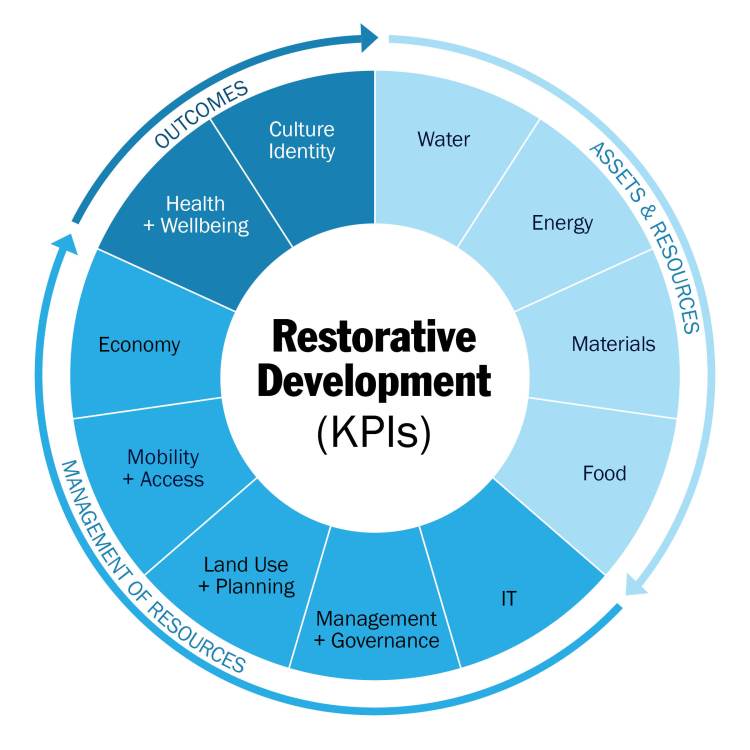
- Community Workshop 1, January 14 2021: Introduction and Initial KPIs. Understanding and commitment to restorative development; Feasibility Study Phase 1 deep dives into first four key performance indicators, scores, and technical analysis.
- Presentation with speaker notes
- Workshop video
- Deep dives for key performance indicators: Water, Energy, Materials, Food
- Community Workshop 2, January 25 2021: Equity and Remaining KPIs. Building equity-centered communities; Feasibility Study Phase 1 deep dives into remaining seven key performance indicators and scores.
- Presentation with speaker notes
- Workshop video
- Deep dives for key performance indicators: Information Technology, Smart City, and Artificial Intelligence; Land Use and Planning; Mobility and Access; Economy
- Participants
- Community Workshop 3, February 3 2021: Alignment and Moving Forward. Aligning RD with Partner priorities: goals and gaps, opportunities, conflicts, untapped synergies. Phase 2: what it is, what it means, how to move forward.
- Community Q&A, cumulative for all January-February 2021 workshops
Work sessions and communications
- 2020 August 20: Presentation (video), City Scorecard update to the Partnership leadership team by the Feasibility Study consulting team
- 2020 July 22: Presentation (slides), Feasibility Study update to the Partnership leadership team
- 2020 April 13: Briefing (memo) to the Partnership
- 2020 February 5: Feasibility study kickoff, full Partnership
 Restorative Development Partnership